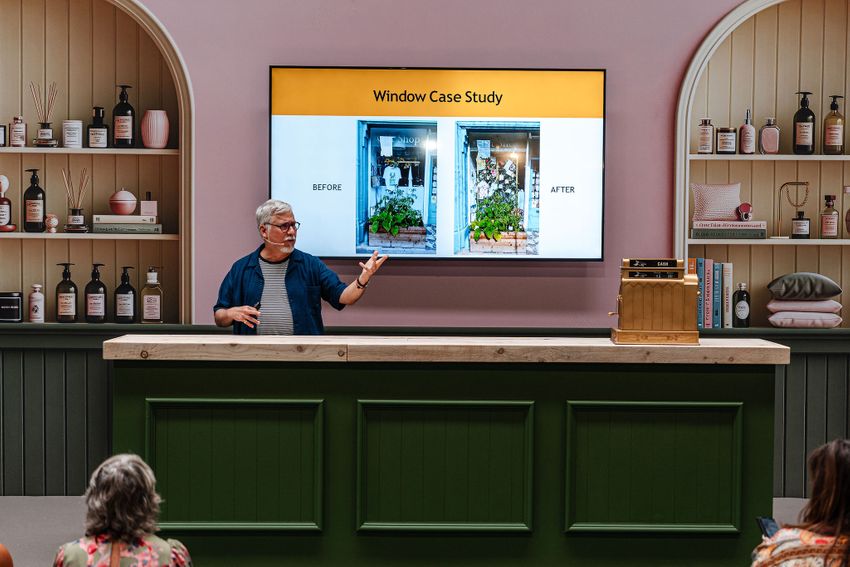
Most independent retailers know their window matters. The hard part is knowing what to do with it when stock has just landed, and the last display went up in a rush the night before. That was the starting point for John Abbate's session on the Counter Talks Stage at Autumn Fair 2026.
John spent more than 20 years in visual merchandising and store design for brands including Ralph Lauren, Levi's and Alfred Dunhill, and now supports small businesses as Economic Growth Lead for High Streets at Westminster City Council. His aim was to share the thinking big retailers rely on, building on why visual merchandising is now a marketing strategy.
Why should you think of your shop like a book?
John's favourite analogy is one he came up with himself. Your storefront and window are the cover. Once a customer is inside, your zones are chapters, your fixtures are paragraphs and your products are the words, with the space between them acting as punctuation.
"It'd be very difficult to read a book if it just went on and on," he said, and a shop with no breaks is just as hard to shop.
What is a brand deck and why should you start there?
Before touching a window, John asks retailers to build a brand deck: a short presentation covering who you are, your unique selling point, your mission, your customers, your competition and what your brand looks like, with a mood board and a handful of keywords.
Taba Naba, one of the winners of the Retail Makeover Mission, landed on words like creative, fun, connection, affordable, family and sustainable. It also defined its customers as mothers aged 25 and over, and women over 55 buying gifts for grandchildren, nieces and nephews.
John encouraged retailers to go further and picture where those customers eat, holiday and shop. "You're just one point in their journey," he said, so the shop should feel like part of that world. He also urged independents to think like brands, noting that Ralph Lauren began with a single tie table.
How do you plan window displays without the last-minute panic?
Once the brand deck exists, it becomes your formula. John admitted Ralph Lauren windows repeated themselves for years because the brand knew its stories so well, and the same deck settles smaller questions like what colour to paint the walls.
He recommended mapping out the year in advance, spending more on windows for your biggest trading periods and keeping quieter months simple.
If something isn't selling, the window can help shift it, but only when it's wrapped in a story. "The same thoughts that you had when you bought it, you need to communicate," he said.
What makes a window display stop people walking past?
If someone stops for two seconds, that's a win. John described window display as basic art composition: balance, a focal point, repetition, rhythm, triangular groupings, proportion and a story.
Windows also need to change roughly every three months, or they become invisible to regular passers-by. And effort is noticed. "If you're really lazy about your window display, what's that telling them?"
At Taba Naba, a council grow-your-own initiative had filled the frontage with vegetable planters, and the window held campaign t-shirts rather than stock. Instead of clearing the plants, John's team leaned into them, buying a garden trellis and fake vines and hanging products as if they were growing. The window now holds far more stock.
Why does your store need to be an experience?
With more than a quarter of UK retail sales now happening online, people don't need to visit you. They come for an experience: trying things on, chatting to someone who remembers their name, meeting friends. It's a big part of why more shoppers are choosing independent retailers.
One idea John loved was a wishing tree, where customers hung handwritten wishes on the branches and became co-creators of the display.
How should you lay out your shop floor?
John recommends a zone plan that keeps each category in one place. A hotspot table near the entrance should act as an extension of the window, and your bestsellers can sit towards the back so people travel through the whole store to reach them.
The back wall is one of the first things people see. At Taba Naba, an eye-catching unit tucked into a blind spot was moved to the back wall and filled with premium candles, which instantly looked more expensive. "The worst thing is that you have something expensive that looks cheap," John said. For blind spots you can't fix, he suggested a bold background colour and regular product rotation.
Should you merchandise by lifestyle or by category?
Lifestyle displays tell a story and are common across homeware and interiors, while category displays group similar products so they're easier to shop. John's advice is to combine the two.
A womenswear boutique owner in the audience found customers bought more when items were grouped by category rather than colour story. John suggested lifestyling the middle of a long rail and flanking it with category or colour, then rotating stock through that central section, an approach that suits fashion boutiques well.
For a pop-up trader worried about clutter, John warned that showing everything at once can leave shoppers too overwhelmed to buy. Pick one "chapter" per event and keep extra stock in boxes under the table, as long as you're ready to tell people there's more.
How can your shop help you sell online?
John's final point was that independents should sell online too. Rather than shooting products on a white background, use your shop as the backdrop so the experience carries through.
If you like what you've seen here, why not join us in person for the retail event of the season? Spring Fair runs from 7-10 February 2027 at the NEC, Birmingham. Register for free here, and join our newsletter for the latest updates before the show.
Featured Articles
- 1 5 Stunning Homeware Suppliers you Need to Know About
- 2 Celebrating Inspiring Women in Retail: Spring and Autumn Fair's Commitment to Championing Women in Retail
- 3 UK Retail Insights 2025: Consumer Caution and Selective Spending
- 4 Theo Paphitis: Small Businesses, Big Impact
- 5 A Fireside chat with Olivia Bowen and Keplin CEO Ray Mehra